"Our ERP works great, but it doesn't talk to our other systems."
It is a refrain we hear from clients with striking regularity. The ERP holds the finance and operations data, while a separate application, typically an older one, holds information the business relies on every day. Each runs on its own data formats and processes, and neither was designed to communicate with the other.
Our technical team recently delivered Oracle EBS integration projects for two clients. In both cases, we connected Oracle E-Business Suite to a third-party legacy application, and data now flows in both directions in real time. Below is an account of the challenge and how we resolved it.
Both clients held business-critical data that had to move between Oracle EBS and an external system. Until recently, that movement depended on manual data entry, batch file transfers and ad-hoc scripts.
Such workarounds can hold for a time, but they slow teams down and allow errors to creep in. They also expose the business to risk, since no one can be fully confident that the figures in both systems agree.
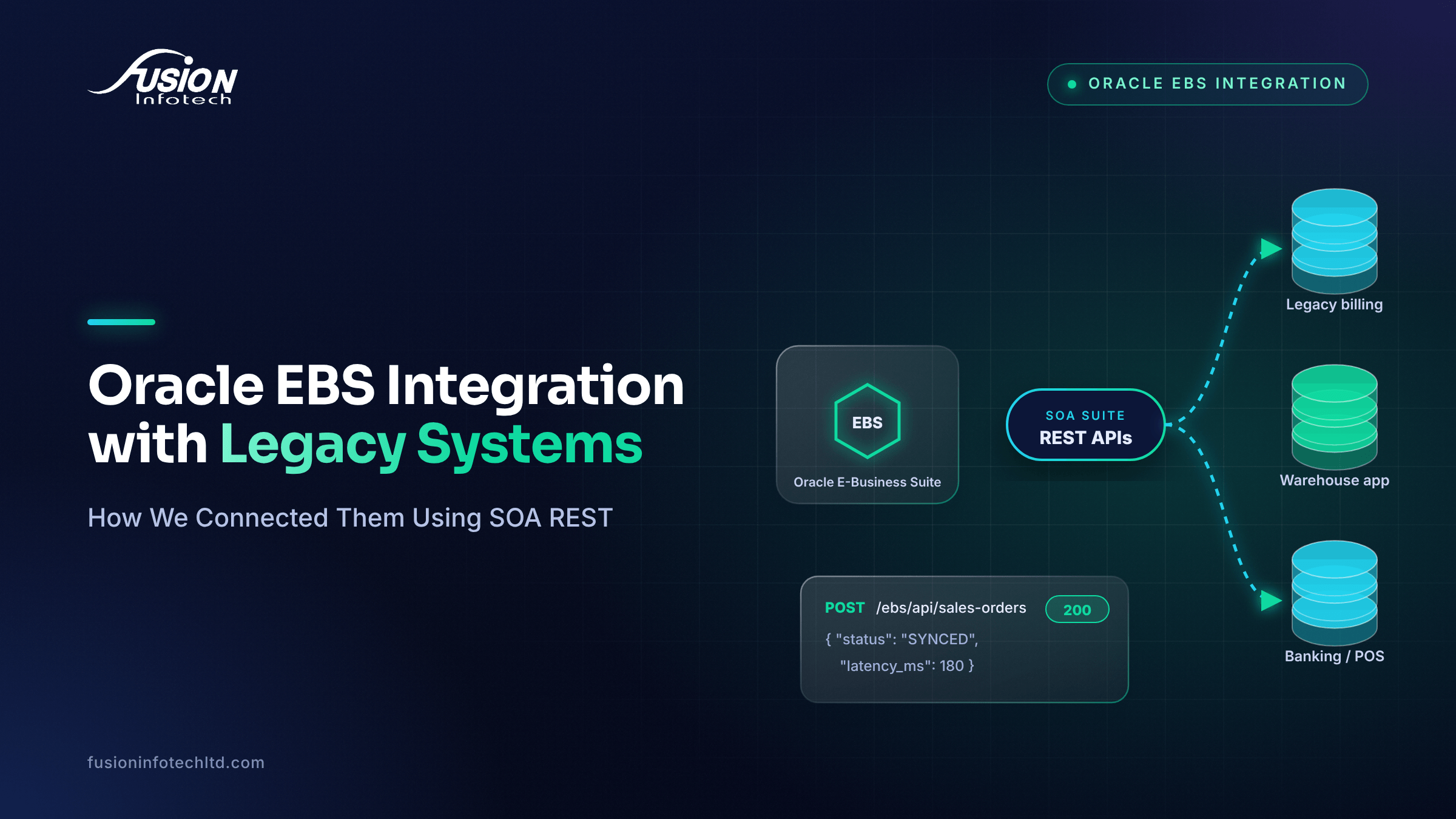
Rather than layering on another stopgap, we engineered a robust SOA REST integration between Oracle EBS and the legacy systems. Neither platform had to change. The integration sits between them and manages data flowing in both directions.
The legacy system transmits its data in a structured format. Records first land in a staging area within Oracle EBS, known as interface tables, where they are validated. Only clean records proceed into the core system through API-driven processes. Records that fail validation are held back at that point, so they never reach finance or operations data.
When a change occurs in Oracle EBS, the update is pushed to the legacy system immediately. Both systems remain synchronised without anyone having to export, copy or re-key data. This is what we mean by real-time data exchange.
Error handling and validation are built into every stage, and each transaction either completes in full or does not proceed at all. That prevents partially processed records from entering the system. The objective is straightforward: data should arrive accurately the first time.
Because the solution is built on REST-based service patterns, connecting additional systems in future does not mean starting over. Each new connection can follow the same proven design.
For both clients, information now moves between systems faster and with markedly fewer errors. Reconciliation that once required manual effort now runs automatically, freeing teams to focus on higher-value work rather than chasing data from one system to another.
Integration does not require a large-scale undertaking to deliver value. A conversation is worthwhile if any of the following sounds familiar:
- Staff enter the same data into more than one system.
- Reports drawn from two systems fail to reconcile.
- Someone must run a file daily or weekly to transfer data across.
- Only one person understands how the legacy script works.
- A new application has been put on hold because connecting it appears too complex.
Modest planning up front prevents considerable difficulty later. Before embarking on any legacy system integration, align your team on the following:
- Which data needs to move, and in which direction?
- How quickly must it move? Is real time essential, or will a daily update suffice?
- What should happen when a record fails?
- Who will own and maintain the connection after go-live?
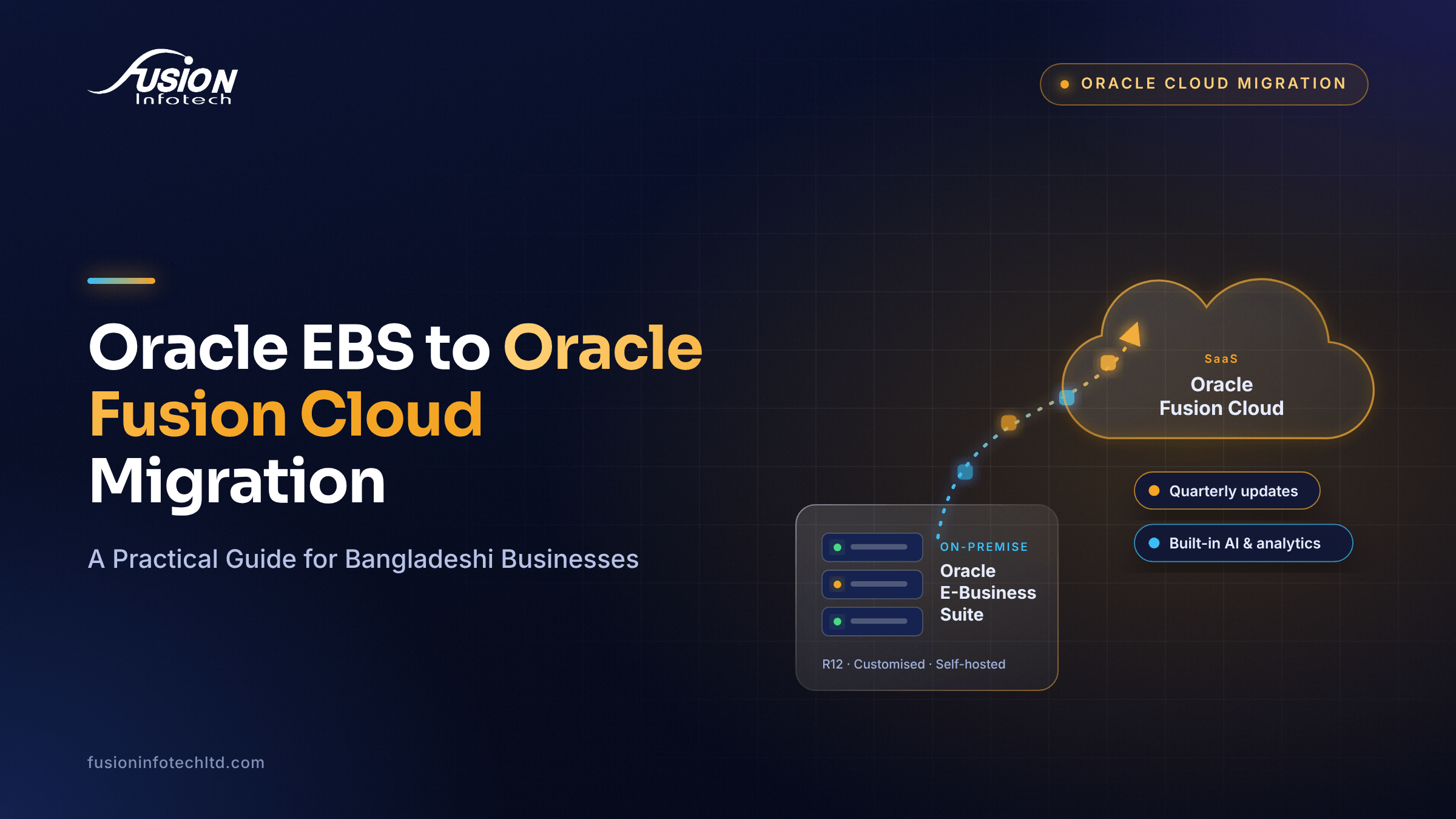
When a business sets out to modernise, the instinct is often to replace legacy systems outright. At times that is the right call, and for organisations weighing that path, our guide on moving from Oracle EBS to Oracle Fusion Cloud can inform the decision. Frequently, however, the smarter first step is to build a sound connection between the systems the business already depends on. What works is preserved, and day-to-day operations continue without disruption.
To learn more about what Oracle EBS can deliver for your business, read
Speak with our team. We will assess your current landscape, set out what is realistically achievable, and recommend a practical approach to integration. You can also meet the Oracle ERP Bangladesh team behind this work.



© 2026 Fusion Infotech Ltd. All rights reserved.